
Clark County Court Records After Arrest
Clark County is part of Missouri's 1st Judicial Circuit. The Clark County Circuit Clerk states that Missouri Case.net can be used to find information for public 1st Judicial Circuit cases, including traffic, misdemeanor, felony, protection-order, civil, domestic, probate, juvenile, adoption, termination, and child-support case types when public and available in the court automation system. For court records after a jail arrest, the key shift is from the booking record to the formal case record.
A jail record can show arresting-agency charges at the time of booking. A court record shows what the prosecuting attorney filed, what the court accepted, and what happened after filing. Clark County's prosecuting attorney is Lindsay Gravett, and that office is the local charging authority after an arrest. Once a case is filed and public, Case.net is the court channel for the case number, parties, charges, docket entries, hearings, and payment options where allowed.
Booking and court records are related, but they answer different questions. The custody side belongs with Clark County jail inmate records. Booking photos and roster image limits belong with Clark County jail mugshots. The court record is the charge and case file path after the arrest.
Search Clark County Court Records
The Clark County Circuit Clerk links users to Missouri Case.net for public court cases. Search by case number when a citation, warrant, jail roster, or court notice provides one. Search by litigant name when two citations, missing paperwork, or uncertain case numbers make a number search impractical. Narrow results to Clark County or the 1st Judicial Circuit when the statewide search returns unrelated cases.
- Open Missouri Case.net and choose a case-number or party-name search path.
- Enter the defendant's name or case number, then narrow by Clark County or the 1st Judicial Circuit when possible.
- Open the public case and review the charge list, filing date, docket entries, bond orders, and next hearing date.
- Compare the court charges to the booking charges, because the prosecutor may amend, reduce, add, or dismiss charges after arrest.
- Call the Clark County Circuit Clerk at 660-727-3292 for court-record questions, understanding staff cannot give legal advice.
For tickets, the clerk notes that entry into Case.net can take up to 25 days and says to use Plead and Pay if that button is available. That statement is specific to tickets and payment-eligible matters. It is not a general deadline for all criminal filings after a jail arrest.
| Field Label | Type | Required | Options / Format Notes |
|---|---|---|---|
| Case Number | Text | Optional/search path | Use the case number found on a ticket, roster, notice, or court document. |
| Litigant Name / Party Name | Text | Optional/search path | Use when the case number is unknown or multiple citations block a number search. |
| Filing Date / Court Date | Date/filter | Optional | Useful for narrowing statewide results. |
| Court / County | Dropdown/filter | Optional | Choose Clark County or the 1st Judicial Circuit where available. |
| Plead and Pay | Action/button | Conditional | Available only on eligible tickets or cases after the matter is in Case.net. |
The Clark County Circuit Clerk page lists Case.net as the official court lookup route and gives local clerk contact information.
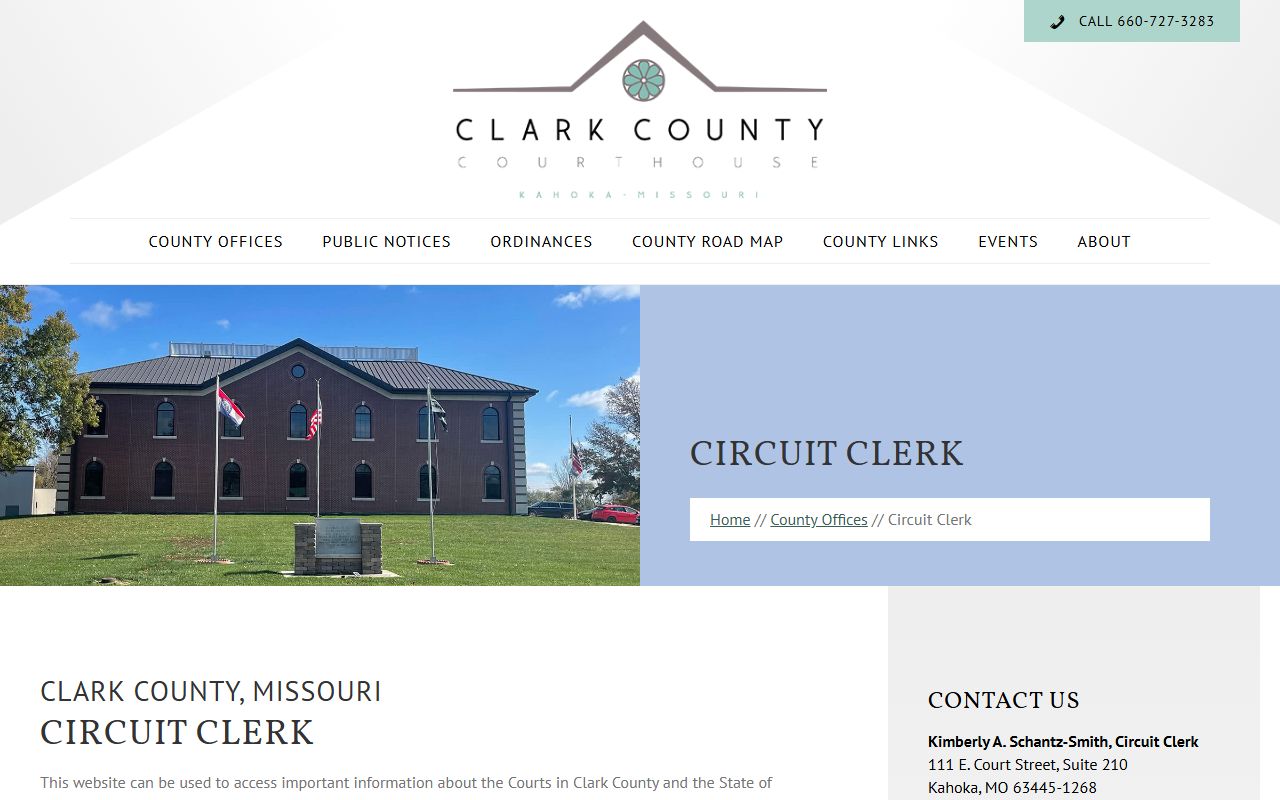
The circuit clerk source is important because it ties the statewide Case.net portal to Clark County's local court office and 1st Judicial Circuit cases.
Clark County Charging Records
After a Clark County jail arrest, the prosecutor reviews the police report, arrest facts, and available evidence. A court case begins when a charging document is filed and accepted through the court process. The exact document type depends on the case type and procedure. The table below uses common Missouri criminal-case terms without assuming that each Clark County arrest uses each document.
| Document | Who Starts It | What It Does | What to Check |
|---|---|---|---|
| Complaint | Prosecutor or authorized complainant | Starts or supports a criminal accusation in court. | Offense description, date, defendant, and probable-cause basis. |
| Information | Prosecuting attorney | Formal charging document used for many criminal filings. | Filed charge, count, level, amendments, and prosecutor signature. |
| Indictment | Grand jury | Formal accusation returned through grand-jury process where used. | Counts, offense level, and whether later amendments appear. |
The charging record can differ from JailTracker. A roster charge may reflect what the arresting agency used at booking. A filed charge reflects the prosecutor's court decision. Later docket activity may show a charge amended, reduced, dismissed, or resolved by plea, trial, or other court action.
Clark County Charge Status
Charge status is the court's current public view of a filed count. A status field is not a final judgment unless the docket or disposition says so. Read the full case entry, not just the first charge line, because the same case can include multiple counts with different outcomes.
| Status | What It Means | Why It Matters |
|---|---|---|
| Pending | The charge remains open and has not reached final disposition. | Hearings, bond orders, or plea settings may still be active. |
| Amended / Reduced | The filed charge changed after prosecutor or court action. | The booking charge may no longer match the active court count. |
| Dismissed | The court or prosecutor ended that charge without a conviction on that count. | Other counts or related cases may still remain. |
| Nolle Prosequi | The prosecutor declines to continue that charge. | It is a court status, not the same as an expungement. |
| Disposed | The court has entered an outcome for the charge or case. | Review the judgment or docket text to see the result. |
Clark County Court Contacts
The Clark County Prosecuting Attorney is the charging office after an arrest. The Clark County Circuit Clerk is the court-record office for case records, docket questions, and Case.net help. Clerk staff cannot give legal advice, and the prosecuting attorney's office does not serve as a public defense or case-advice office for defendants.
Clark County Prosecuting Attorney
Lindsay Gravett, Prosecuting Attorney
111 E Court Street, Ste 20
Kahoka, MO 63445-1268
660-727-2616
Email: clarkcountytraffic@gmail.com
Clark County Circuit Clerk
111 E Court Street, Suite 210
Kahoka, MO 63445-1268
660-727-3292
Hours: Monday-Friday, 8:00 a.m.-12:00 p.m. and 1:00-4:00 p.m.
Bond and Warrant Records
Bond information may appear in JailTracker and in the court case, but the court order controls the formal bond setting after appearance. Clark County did not publish a jail bond payment page or local bond fee table. Before bringing money, arranging a bond agent, or relying on a roster bond field, call Clark County Jail at 660-727-2911 and check Case.net once the case is filed.
| Bond Type | How It Works | Clark County Checkpoint |
|---|---|---|
| Cash bond | Money is posted with the court or jail as required by order. | Confirm payment method before arrival. |
| Surety bond | A bond agent posts security under the court's terms. | Verify the bond is allowed for the case and no hold blocks release. |
| PR bond | Personal-recognizance release without full cash deposit. | Check the court order and any conditions. |
| No-bond hold | Ordinary payment does not release the person. | Look for warrants, detainers, probation/parole holds, federal holds, or ICE holds. |
No official Clark County active-warrant search page was located. Warrant questions may require a sheriff call, a Case.net search, or a circuit clerk contact. A bench warrant may appear in a public docket, often after a failure to appear. An arrest warrant may lead to a jail booking, but some details can be sealed, unavailable online, or tied to an active investigation.
- Arrest warrant
- A court order authorizing arrest on a criminal accusation.
- Bench warrant
- A judge-issued warrant, often for failure to appear or violation of a court order.
- Detainer
- A hold from another county, state, federal agency, probation/parole office, or immigration authority.
Charges vs Convictions
Being arrested, booked, or charged is not the same as being convicted. A charge is an accusation or filed count. A conviction is an outcome after a plea, verdict, or other qualifying judgment. Court records after an arrest should be read with that distinction in mind, especially when a booking charge appears online before court action is complete.
| Point of Comparison | Charge | Conviction |
|---|---|---|
| Stage | Accusation or filed count after arrest. | Final result through plea, verdict, or judgment. |
| Proof level | Based on probable cause or charging review. | Requires a legally sufficient conviction process. |
| Can change? | May be amended, reduced, or dismissed. | Can still be appealed, set aside, or affected by later relief. |
| Where checked? | Case.net charge list and docket entries. | Judgment, disposition, criminal history, or certified court record. |
Sealed and Expunged Records
Missouri law restricts public access to closed criminal records under RSMo 610.120, except as allowed by law. A public Case.net search may not show juvenile, closed, expunged, sealed, or otherwise restricted records. A dismissal is also not the same as a sealed or expunged record. The public docket can remain visible unless a separate legal process closes or removes access.
| Point of Comparison | Sealed or Closed | Expunged |
|---|---|---|
| Public visibility | Generally not available to the public except as allowed by law. | Public access is removed under the expungement order and related law. |
| Agency access | Some justice agencies may retain lawful access. | Access depends on Missouri expungement law and the order. |
| How it happens | By statute, court order, juvenile rule, or protected-record status. | By petition and court order when legally eligible. |
| What to verify | Ask the court for certified status if needed. | Confirm the order applies to the specific arrest, charge, or case. |
Public Access Limits
Missouri's Sunshine Law makes arrest and incident reports open records under RSMo 610.100, but investigative reports and protected details can be closed or redacted. That matters after a jail arrest because the public may be able to see basic arrest facts while still being unable to see investigative notes, juvenile information, victim details, sealed filings, or safety-sensitive information.
For statewide criminal-history checks, the Missouri State Highway Patrol Criminal Justice Information Services channel explains open and closed criminal-history access. That is different from browsing a court docket. A formal background check may require authorized procedures, fees, consent, or statutory access rules. Case.net, JailTracker, and arrest reports are useful public lookup tools, but they should not be treated as complete criminal-history products.
Important: Do not use jail, court, or custody lookup results for employment, credit, housing, insurance, or any FCRA-covered decision.